

Why patience covers everyday friction and forgiveness heals real grievances.
Colossians 3:13 comes from a short, powerful letter Paul wrote to the church in Colossae, a small city in Asia Minor (modern-day Turkey). The church there was made up of a diverse mix of people – Jews and Gentiles, rich and poor, masters and slaves – who were all trying to live as one new family in Christ.
They were also being pressured by false teachings that mixed Jewish laws and pagan philosophies, so it was very confusing. Paul writes to them to help them focus on Jesus.
In chapter 3, Paul focuses on everyday life, telling them to “put to death” the old ways of living that included sexual immorality, greed, anger, and filthy language. Then he gives a list of characteristics that Christians can use as they begin living their new lives in Christ – compassion, kindness, humility, gentleness, patience, and love. And just as important, to forgive each other.
Paul knew that real churches weren’t perfect. Real people are quirky and slow to change, sometimes even unaware of their own rough edges. Real communities of people sometimes rub each other up the wrong way, and that’s why this scripture is so important.
The Verse
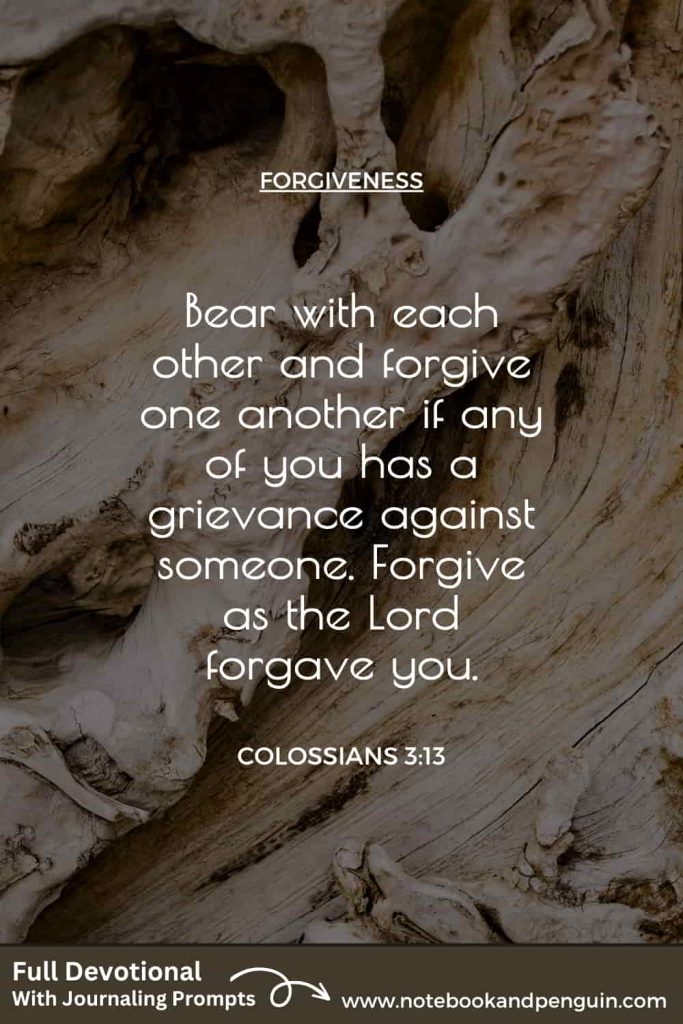
Bear with each other and forgive one another if any of you has a grievance against someone. Forgive as the Lord forgave you.
Colossians 3:13 (NIV)
Breaking down Colossians 3:13
“Bear with each other…”
To “bear with” means to put up with, to endure, to be patient with people even if they hurt or irritate you. It’s what you do when someone loads the dishwasher “wrong,” talks too long in a small group, or repeats the same mistake at work despite training. But it’s not a passive-aggressive tolerance. Rather, it’s active patience driven by love. You’re saying, “I will give you room, the same way God gives me room.”
“…and forgive one another if any of you has a grievance against someone.”
A “grievance” is a real complaint, a wrong that created a debt. This could include things like unkept promises, sharp words, a betrayal, a lost opportunity. Paul doesn’t deny it. He acknowledges that in the church and relationships, there will be grievances. His solution isn’t denial but forgiveness. This doesn’t mean calling evil good or pretending it didn’t hurt. It means you refuse to be ruled by the injury or to look for payback.
“Forgive as the Lord forgave you.”
How did the Lord forgive you? Freely. Fully. At an incredible cost to Himself. God’s forgiveness in Christ is not stingy. He cancels our unpayable debts and welcomes us as beloved children. Paul reminds us that you can forgive because you’re not drawing from your willpower alone, you’re drawing from God’s mercy toward you.
Important Things To Remember
- Forgiveness and trust are not the same thing. Just because you choose to forgive someone, that doesn’t mean that they can and should be trusted. Trust is rebuilt slowly with consistent change.
- Forgiveness does not mean staying in harm’s way. Boundaries are important and wise. Your safety matters. If there’s any abuse or ongoing manipulation, look for help and take protective steps.
- Forgiveness does not erase consequences. You can forgive while still telling the truth and pursuing justice through legal means if necessary.
Faith in Action
Here are a few simple, concrete steps you can try this week to help you put Colossians 3:13 into action. Start small. Be honest and invite the Holy Spirit to help you.
Make a “bear with” list.
Write down three everyday things that people close to you do that irritate you. Next to each one, write a compassionate response: “They’re not careless; they’re overwhelmed.” Or, “They process out loud; it’s how they think.” Pray: “Lord, help me bear with this in love.” Doing this simple exercise can help to lower your frustration and see things from their perspective.
Name the grievance, then release the debt.
If there’s a real offense, write it down plainly. What happened? How did it impact you? What do you feel is “owed” (an apology, time, respect, repair)? Then pray: “Jesus, because You forgave me, I choose to forgive [name]. I release the debt of [what they owe]. I entrust justice and timing to You. Heal my heart.” If emotions spike later, repeat. Forgiveness is often a repeated decision until your feelings catch up.
Practice a 24-hour pause before hard conversations.
When you feel heated, wait 24 hours before you send the message or have the talk. In that pause, ask: Is this a “bear with” issue or a “forgive” issue? If it’s “bear with,” let it go in love. If it’s “forgive,” schedule a calm, clear conversation.
Use the “truth + tenderness” script.
If reconciliation is possible, try this: “I value our relationship. When [specific event] happened, I felt [emotion]. I’m choosing to forgive and would like to talk about how we can move forward.” Avoid piling on. Stay specific. Invite dialogue and listen well. If needed, bring in a trusted mediator or leader to help keep the conversation safe and productive.
Pair forgiveness with wise boundaries.
Ask God, “What boundary would honor You, protect my heart, and give this relationship the best chance to heal?” Examples: clearer roles at work, time-limited meetings, or meetings in public spaces. Boundaries aren’t punishment; they’re structure for peace.
Keep a gratitude journal of God’s forgiveness.
Each day this week, note one way God has shown you mercy and forgiveness. Gratitude softens your heart and keeps you connected to the source that empowers you to forgive others.
Reflection Questions
- Is there a specific grievance you’ve been carrying? What debt do you feel is owed, and what would it look like to release that debt to God instead of carrying it yourself?
- When you think of how “the Lord forgave you,” which moments or stories come to mind? How could remembering how God forgave you shape your response to someone who failed you?
- Where do you need boundaries to practice forgiveness wisely and safely? What specific boundary would help?
- Do you tend to treat “bear with” issues as “forgive” issues (or vice versa)? How can you start to separate the two?
- If reconciliation is possible, what’s one step you could take this week toward an honest, gentle conversation?
Affirmation
Today I choose to bear with others in love and to forgive real grievances, releasing debts and trusting God with justice and healing.
Closing Prayer
Lord Jesus,
Thank You for forgiving me at great cost and for bearing with me in love as I grow. Fill me with Your compassion and patience. Show me what to overlook in love and what to address with truth and grace. Where I have a grievance, help me release the debt to You and walk in freedom. Give me wisdom for boundaries and courage for honest conversations. Keep my heart soft, my words gentle, and my actions rooted in Your mercy. Make my life a small reflection of Yours.
Amen.