
You’re not a work in progress, you’re God’s masterpiece in progress
Imagine walking through an art studio and seeing half-finished paintings everywhere. Canvas after canvas with beautiful beginnings, but nothing completed. You might wonder: Did the artist get bored? Did they run out of inspiration? Did they decide the paintings weren’t worth finishing?
Now imagine meeting the artist and asking about all these unfinished works. What if they said, “Oh, I always start projects, but I never finish them. I lose interest or give up when things get difficult.”
You probably wouldn’t have much confidence in that artist’s ability to complete any future work. But what if instead they said, “I’ve never left a painting unfinished in my entire career. Every work I begin, I complete to perfection”? That would be an artist you could trust with your most precious projects.
This is exactly the kind of artist God is, except instead of painting on canvas, He’s working on human hearts and lives. When the apostle Paul wrote to the church in Philippi, he wanted them to The Character & Attributes Of God: God always finishes what He starts.
Paul wasn’t writing these words during an easy time. He was in prison, facing an uncertain future. The Christians in Philippi were also facing challenges and persecution. It would have been easy for both Paul and the Philippians to wonder if God had given up on them, if their faith journey was worth continuing, or if God’s work in their lives would ever be completed.
But Paul had learned something incredible about God’s faithfulness. He had discovered that God doesn’t start projects He won’t finish. When God begins a work in someone’s life, He is committed to seeing it through to completion, no matter how long it takes or how many obstacles arise.
Related: The Unchanging Character & Attributes Of God (With Free 30-day) Reading Plan
Today’s Scripture
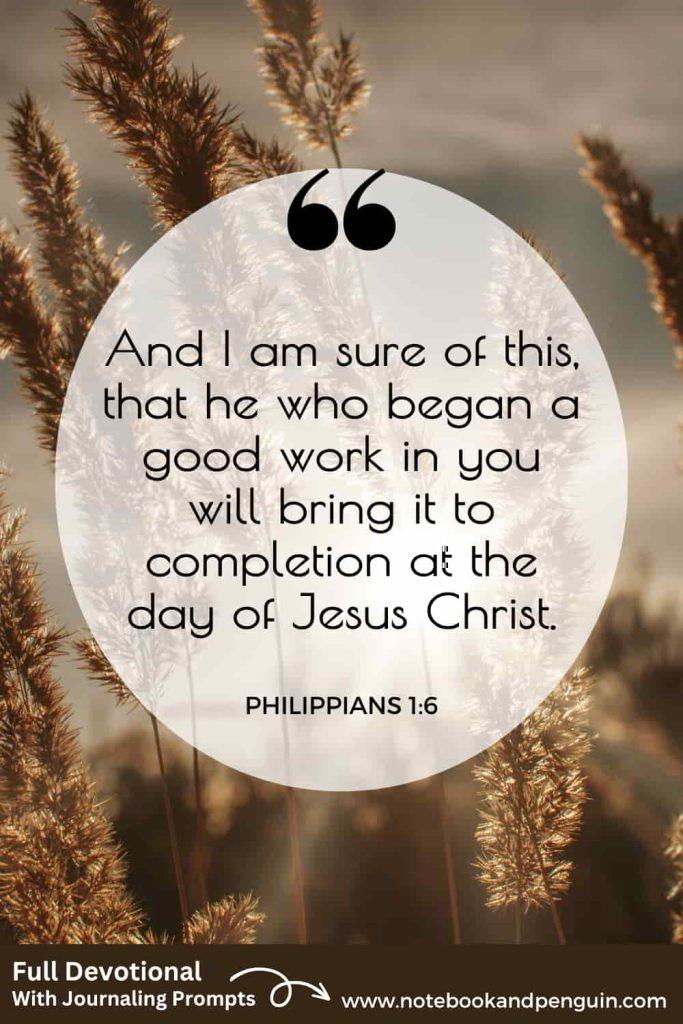
“And I am sure of this, that he who began a good work in you will bring it to completion at the day of Jesus Christ.”
Philippians 1:6
Breaking Down the Verse
Let’s take a look at each part of this encouraging promise about God’s commitment to finish what He starts.
“And I am sure of this”
Paul isn’t expressing a hope or a wish. He’s stating a certainty. The Greek word he uses means to be confident, convinced, or persuaded. This isn’t wishful thinking, it’s rock-solid confidence based on Paul’s understanding of God’s character.
Paul had seen God’s faithfulness over and over again in his own life and in the lives of others. He had watched God transform hearts, change lives, and work miracles. Based on all this evidence, Paul could say with absolute certainty that God finishes what He starts.
This confidence wasn’t based on Paul’s feelings or circumstances. Even though he was in prison, even though he faced opposition, Paul’s confidence was unshakable because it was based on who God is, not on what was happening around him.
“that he who began”
God is the one who starts the work. We don’t manufacture our own spiritual transformation. We don’t create our own relationship with God. We don’t begin our own journey of faith. God is always the initiator.
This is incredibly encouraging because it means that if you’re aware of God working in your life, it’s because He started that work. If you have any desire to know Him better, any longing to become more like Jesus, any sense that He’s calling you to something, that’s God beginning His work in you.
The word “began” also implies that this is an ongoing process, not a one-time event. God doesn’t just start something and then step back. He begins the work and continues to be actively involved in every step of the process.
“a good work in you”
God’s work in us is always good. He’s not trying to harm us, limit us, or make our lives miserable. Everything God does in our lives is for our benefit and blessing. Even when His work involves difficult seasons or challenges, His ultimate purpose is always good.
The phrase “in you” shows that God’s work is personal and internal. He’s not just changing our circumstances or our environment. He’s transforming us from the inside out. He’s working on our hearts, our thoughts, our character, and our relationship with Him.
This good work includes many things: forgiving our sins, healing our hurts, developing our character, growing our faith, teaching us to love others, and preparing us for eternity with Him. It’s comprehensive work that touches every area of our lives.
“will bring it to completion”
This is the heart of the promise. God will finish what He started. The Greek word for “completion” was often used to describe finishing a building or completing a work of art. It means to bring something to its intended end, to perfect it, to make it complete.
God doesn’t leave His work half-done. He doesn’t get distracted by other projects. He doesn’t run out of time, energy, or resources. He will complete the work He’s begun in you, bringing it to the perfect end He has planned.
“at the day of Jesus Christ”
This refers to the day when Jesus returns and we see Him face to face. It’s the ultimate completion of God’s work in our lives. While God is working in us every day here on earth, the final perfection of His work will happen when we are with Him in eternity.
This gives us both hope and perspective. We don’t have to be perfectly completed right now. God’s work in us is ongoing, and He has all the time He needs to finish what He’s started. We’re not behind schedule, we’re exactly where God intends us to be in His timeline.
Faith in Action
Knowing that God will finish what He started should change how we view ourselves and our spiritual journey. Here are practical ways to live out this promise:
1. Be Patient with Your Growth Process
Spiritual growth takes time. You don’t have to be perfect right now or even next year. God is patiently working in you, and you can be patient with yourself too. Trust His timing and His process.
2. Don’t Give Up When Growth Feels Slow
There will be times when you feel like you’re not making progress, when you struggle with the same issues over and over, or when you wonder if you’re actually changing at all. In those moments, remember that God doesn’t give up on you. He’s still working, even when you can’t see it.
3. Cooperate with God’s Work
While God is the one who completes the work, we’re not passive in the process. We can cooperate with what God is doing by reading His Word, praying, spending time with other believers, and obeying what He shows us. Think of it as working together with God on His project.
4. Focus on God’s Faithfulness, Not Your Performance
Your confidence shouldn’t be based on how well you think you’re doing spiritually. Your confidence should be based on God’s faithfulness to complete what He’s started. On days when you feel like you’re failing, remember that God’s commitment to you doesn’t depend on your performance.
5. Look for Signs of God’s Work
Pay attention to how God is working in your life. Notice areas where you’ve grown, times when He’s helped you through difficulties, or ways your heart has changed. Recognizing God’s work builds your confidence that He will continue and complete it.
Dig Deeper With Journaling Prompts
Affirmation
God has begun a good work in me, and He will complete it. I don’t have to be perfect today because God is patiently working in me every day.
Prayer for the Day
Heavenly Father,
Thank You that You don’t give up on me. When I look at my life and see areas that still need work, help me remember that You’re not finished with me yet. Thank You for beginning a good work in my heart and for Your promise to complete it.
Give me patience with Your process and with my own growth. Help me to cooperate with what You’re doing in my life instead of fighting it or trying to rush ahead of You. When I feel discouraged about my progress, remind me that Your timing is perfect and Your work is thorough.
Thank You that I can trust Your faithfulness completely. You are the master artist of my life, and You will complete the beautiful work You’ve started. I rest in Your promise today and look forward to seeing Your finished work.
In Jesus’ name, Amen.