A Simple Guide To Dig Deeply Into Any Scripture.
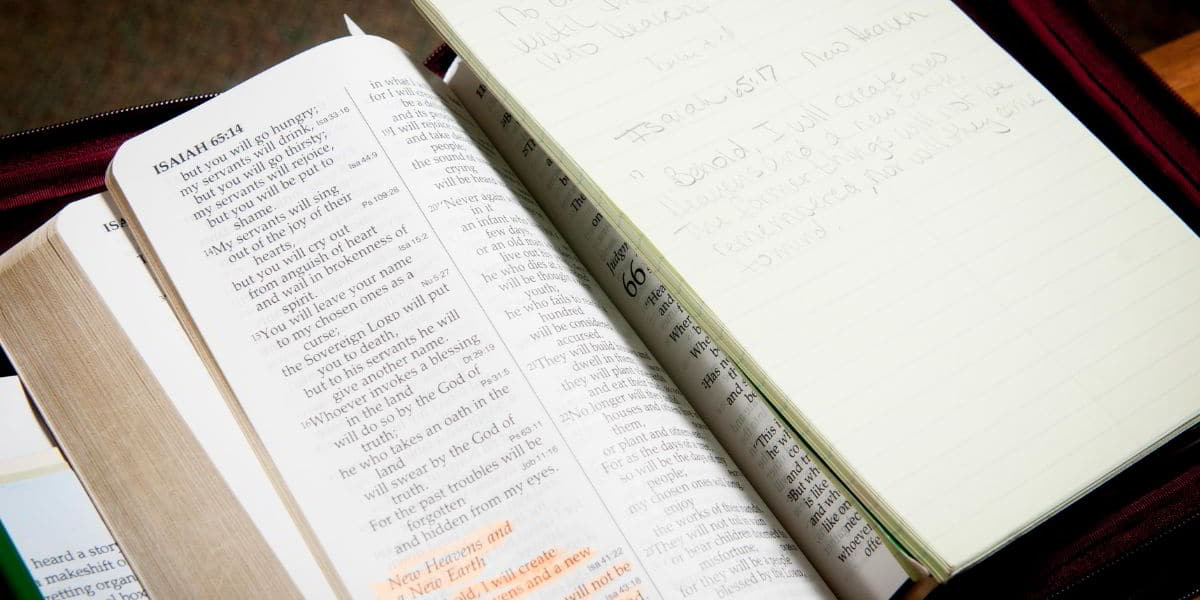
I remember the first time someone mentioned “inductive Bible study” to me. We were at a small group meeting, and a friend was showing us her Bible – pages filled with colorful underlines, strange symbols in the margins, and notes spilling into the cover.
“It’s the inductive method,” she said.
I nodded like I knew what she was talking about, I didn’t… It seemed complicated, academic, and honestly, a bit overwhelming.
But a few months later, feeling stuck in my usual Bible reading, I decided to give it a try. I found a free inductive Bible study PDF online, printed it out, and with a deep breath, opened to a familiar psalm.
At first, it felt awkward and even a little silly, but I realised that by slowing down and asking simple questions, I saw things in that psalm that I’d missed for years. I realised then that the Inductive Bible study method was not just about making my Bible look impressive, but rather a system to help understand it way more deeply.
If you’re feeling like I was – curious but a bit daunted by terms like inductive bible study symbols or inductive bible study color code – then this guide is for you! We’re going to break it down, step-by-step, in plain language.
Trust me, once you try it, it becomes a lot less scary. And I’ve even included a free inductive bible study template and cheat sheet at the end to get you started.
But before we begin…
If you find this guide helpful, please consider sharing it with a friend who might also feel stuck in their Bible study! We’d really appreciate it. 💛

What Is the Inductive Bible Study Method? (Plain English, Please!)
Put simply, the inductive bible study method is about letting the Bible speak for itself.
Instead of starting with a theme or a sermon idea and finding verses to match (that’s deductive), you start with the text itself.
You observe what it actually says, interpret what it means, and then apply it to your life. It’s a way of slowing down, paying attention, and discovering truth firsthand.
Think of it almost like detective work. You’re gathering clues (observation), figuring out what case they solve (interpretation), and then deciding what to do with the solved mystery (application).
How Is It Different? Inductive vs. SOAP, Deductive, and More
You might be wondering how this fits with other methods you’ve tried. It’s a great question, and one a lot of beginners ask.
Inductive vs. Deductive Bible Study
Deductive starts with a general idea or principle and uses the Bible to confirm it. For example, you might start with the idea “God is love,” then look for verses about God’s love to support it.
Inductive starts with the specific text and builds understanding from there. Using the same example, you’d start by studying 1 John 4:8 word-by-word, and through observation, discover the truth “God is love” for yourself.
Inductive is discovery-based; deductive is confirmation-based.
Inductive Bible Study vs SOAP vs WORD
The WORD (Write, Observe, Relate, Declare) and SOAP (Scripture, Observation, Application, Prayer) are actually wonderful, simplified forms of inductive study! They both give you fantastic frameworks, especially for daily devotionals, while the full inductive method gives you more tools for deep-dive study.
Check out our full WORD and SOAP Bible Study Guides here:
- How to Use the WORD Bible Study Method (Step-by-Step Guide + Template)
- Soap Bible Study Method Beginner’s Guide (With Free Templates)
Inductive vs. Expository Bible Study
These are closely related however, expository teaching is often the result of someone doing an inductive study and then explaining a passage verse-by-verse to others. You could say inductive is the personal study method that leads to expository preaching.
The bottom line? There’s no “best” method. The best method is the one that helps you connect with God. But if you’ve ever read a passage and thought, “What am I supposed to do with this?” then the inductive method gives you a practical toolkit.
Why Bother? The Surprising Benefits of Inductive Bible Study
I’ll be honest – this method takes more time than just reading a chapter. So why is inductive bible study important?
Because the benefits go far beyond just checking a box:
- It makes the Bible personal. You’re not just reading someone else’s notes; you’re making your own discoveries. It becomes your conversation with God.
- It builds confidence. You learn how to study and understand Scripture for yourself, which is incredibly empowering.
- It reveals layers of meaning. Slowing down to ask “who, what, when, where, why” uncovers details and connections you’d normally speed right past.
- It sticks with you. The process of writing, marking, and questioning helps cement God’s Word in your heart and mind.
It transforms Bible reading from a duty into a discovery. And that’s definitely worth a few extra minutes!
The 3 Simple Steps: Observe, Interpret, Apply
Don’t let the fancy name fool you. At its core, how to do inductive bible study boils down to three straightforward steps.
Think of them as OIA: Observe, Interpret, Apply.
Step 1: Observation (What Does It Say?)
Your job is to see exactly what’s on the page, without jumping to conclusions.
Ask the “5 W’s and an H”
- Who is writing? Who are they writing to? Who is mentioned?
- What is happening? What are the key events or instructions?
- When did this happen (time of day, season, historical period)?
- Where are the locations mentioned?
- Why is this being said or written? (Look for words like “so that,” “for,” “because”).
- How is it being said? (Tone, emotions, figures of speech).
My beginner tip: Start with just one of these. Pick “Who” for your first time. On your next study, ask “What.” Don’t try to catch everything at once.
Step 2: Interpretation (What Does It Mean?)
Now we ask, “So what?” Based on your observations, what is the main point or truth the author is communicating?
Key questions for interpretation:
- What is the main idea of this paragraph/chapter/book?
- How does the context (the verses before and after) shape the meaning?
- What did this mean to the original audience?
The big rule here: Let Scripture interpret Scripture. If something is confusing, see what other clear parts of the Bible say about the same topic. A good inductive bible study guide or inductive bible study worksheets can help with cross-references, but your own curiosity is the best tool.
Step 3: Application (How Does It Change Me?)
This is where the rubber meets the road. Truth is meant to transform.
Ask yourself:
- Is there a promise to believe?
- Is there a sin to avoid or confess?
- Is there an example to follow (or avoid)?
- Is there a command to obey?
- How does this change how I see God, myself, or others?
Remember: Application is personal. It might be a concrete action (“I need to call and forgive my sister”), or a shift in attitude (“God is my provider, I can choose not to worry about money today”).
Your Toolkit: Symbols, Colors, and Cheat Sheets
This is the part that can seem overwhelming, but it’s also the most fun! Inductive bible study symbols and inductive bible study colors aren’t about being an artist; they’re about creating a visual map to help you.
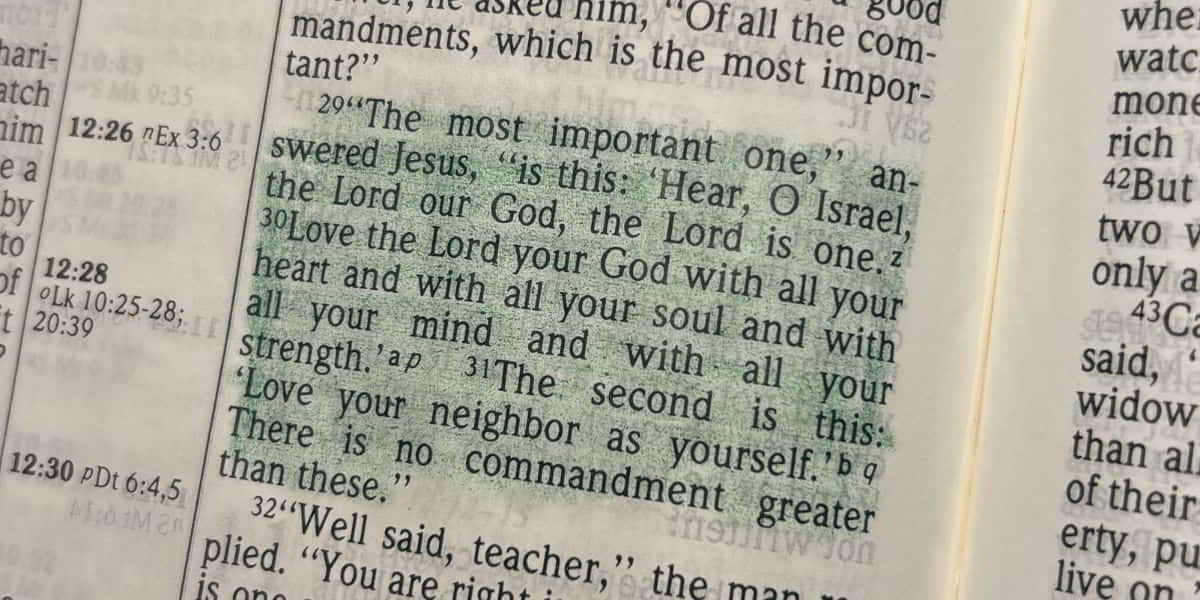
You don’t need a fancy system. Start with Bible color coding using just 3-4 highlighters or colored pencils:
- Yellow: Promises of God
- Blue: Commands (things to do)
- Green: Growth (key verses about faith, character)
- Pink/Purple: Prayer, worship, God’s character
- Red: Warnings
For symbols, keep it simple. Use what makes sense to you in the margins:
- ? = A question I have
- ! = A key insight or wow moment
- ⇧ = A cross-reference (note the other verse)
- ⊛ = A promise
- → = An application for me
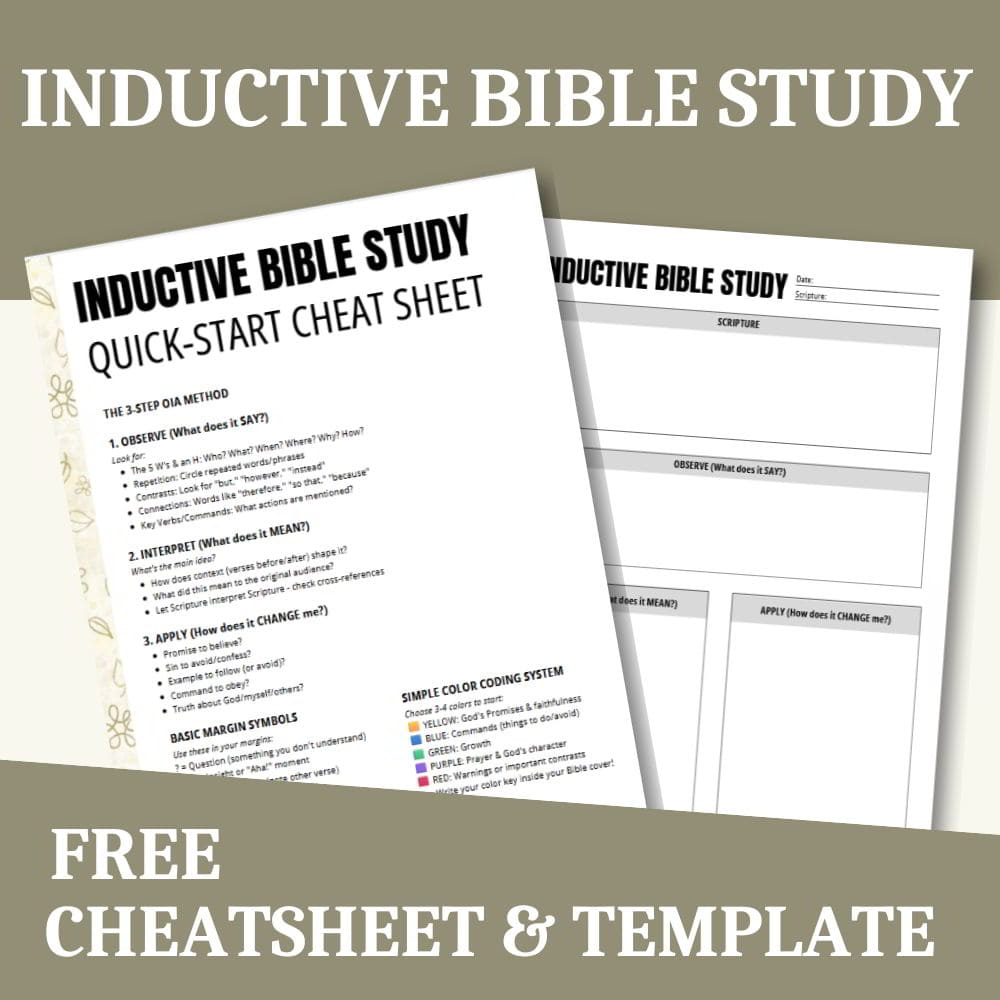
I’ve created a simple Inductive Bible Study Cheat Sheet that you can download and print (at the end of this article). It has these basic symbols and color coding ideas plus a simple worksheet template. It is a great starter template to use until you develop your own shorthand!
Your First Inductive Study: A Simple Example
If you’re thinking, “inductive Bible study, where to start?” – start right here. Let’s take a short, powerful verse and walk through it together.
Let’s study: Philippians 4:6-7 (NIV)
“Do not be anxious about anything, but in every situation, by prayer and petition, with thanksgiving, present your requests to God. And the peace of God, which transcends all understanding, will guard your hearts and your minds in Christ Jesus.”
Step 1: OBSERVE (Grab a pen and write this down!)
- Who/To Whom? Paul is writing to the church in Philippi.
- What? A command: “Do not be anxious.” An action: “present your requests.” A promise: “peace… will guard.”
- How? “By prayer and petition, with thanksgiving.”
- Key Repeated Words? Anything/everything, prayer/petition/requests, peace, guard.
Step 2: INTERPRET
- We exchange our anxiety for God’s peace, through thankful prayer.
- This peace isn’t just a calm feeling, it actually guards our hearts and minds. It’s protective.
Step 3: APPLY
- Command to obey: I am commanded to pray with thanksgiving instead of worrying.
- Promise to believe: If I do this, God’s peace will actively guard my inner being.
- My personal takeaway: When I feel anxiety rising today, I will stop and verbally present that specific worry to God, adding one thing I’m thankful for in that situation.
And that’s it! A real inductive bible study example in action.

5 Gorgeous Real-Life Examples
If you want to see how others use the inductive method then here are a few real-world examples to inspire you!
When You Feel Stuck: Common Struggles (& How to Move Past Them)
I wish I could tell you that every inductive study session feels like a lightning bolt of wisdom and insight. But sometimes, it just feels… hard. Here are the hurdles I’ve faced (and I bet you might too), and what helps.
1. “I’m worried I’ll do it wrong.”
This was my biggest fear! Remember what we said about journaling?
There is no right or wrong way to journal.
The same is true here. There is no perfect way to mark your Bible. The goal isn’t a Pinterest-worthy page, your markings are for you, not for show. Give yourself permission to be messy.
2. “I don’t have time for this deep dive.”
You don’t need an hour. Start with 5 minutes and one verse. Use the OIA steps on just Philippians 4:6. A deep study of a single, powerful verse is far better than skimming a chapter without retaining anything. Consistency with tiny steps beats occasional marathons.
3. “The symbols and colors feel complicated.”
Then ditch them! Seriously. Use a simple pen and just write your questions and thoughts in the margin. The tools are there to serve you, not to rule you. Come back to the inductive bible study color code or symbols only if you find they help you see patterns.
4. “I don’t know what to observe. I just see words.”
Start with the simplest question: What repeats? Circle or underline any word that appears more than once. Then ask: What contrasts? Look for words like “but,” “however,” “instead.” These two tricks alone will unlock so much.
5. “I get stuck on interpretation.”
This is normal! When you don’t know what something means:
- Read it in another translation. Sometimes the wording in the NIV or ESV makes it click.
- Look at the immediate context. Read the 5 verses before and after. The answer is often there.
- Write down your best guess, and then check a trusted commentary or ask a mature believer later. The process of curiosity and wondering is part of the learning.
Be patient and kind to yourself. This is a skill that grows over a lifetime, not something you have to get right today!
Inductive Bible Study PDF Printable
To help you get started I’ve put together a cheat sheet based on this article along with a PDF template that you can either print out or use in your favorite note-taking app.
Free Inductive Bible Study Template And Cheatsheet
Grab your free PDF template and Cheatsheet to help you get started!
Enter your email below, and we’ll instantly send your free templates straight to your inbox!
Your Inductive Bible Study Questions, Answered (FAQ)
You’re not the only one with questions! Here are clear answers to the things people search for most.
Q: What is the inductive bible study method in a nutshell?
A: It’s a three-step method of 1) Observing what the text says, 2) Interpreting what it means, and 3) Applying how it changes your life. It emphasizes discovering truth directly from the text.
Q: What’s the difference between inductive and deductive bible study?
A: Inductive study starts with the specific text and builds conclusions from it (like assembling a puzzle). Deductive study starts with a general principle or idea and uses the Bible to confirm or illustrate it (like using a puzzle piece to prove you have the right puzzle).
Q: Can you give me an inductive bible study example?
A: Absolutely! We walked through one with Philippians 4:6-7 above. You can also find many free inductive bible study pdf guides online that walk you through entire books of the Bible step-by-step.
Q: Where can I get a free inductive bible study template or worksheets?
A: Right here (see the link above)! It includes a simple worksheet for the OIA steps, a symbols cheat sheet, and an example to help you get started.
Q: What are the best inductive bible study colors and symbols?
A: There’s no “best” system, only what works for you. A common starter Bible color coding system is: Yellow for God’s promises, Blue for commands, Green for growth/personal application, and Pink for anything about God’s character or prayer. For symbols, start with a question mark (?) for things you don’t understand and an exclamation point (!) for key insights.
Q: Is inductive bible study for beginners?
A: Yes! Start small. Choose a short, encouraging passage (like a Psalm). Use a simple template. Don’t worry about getting it “perfect.” The goal is to connect with God, not to become a scholar overnight. This entire guide is written as an inductive bible study for beginners!
Q: How is it different from the SOAP method?
A: SOAP (Scripture, Observation, Application, Prayer) is a fantastic, simplified form of inductive study. It covers the core ideas. The full inductive method adds more tools (like detailed observation questions and markings) for when you want to do a deeper dive.
Final Thought: It’s a Journey, Not a Destination
The inductive Bible study method is a tool to help you slow down, listen closely and talk honestly with the God who wrote the Book. Your study doesn’t have to be fancy or neat, and it certainly isn’t about creating a perfect resource. You might even find that the more you get into it the more messy it gets and that’s okay!
So, grab your Bible and a pen. Start with one verse. Ask one question. See what you discover. You never know, you might just have the “lightbulb” moment you’ve been longing for!