
An Easy 4-Step Bible Study Method for Meaningful Quiet Time With Jesus.
Sometimes, when you’re reading your Bible, reading a few verses or one or two chapters is perfect. Other times, you might want to dig a little deeper so that you can really understand what God is saying and how it applies to your life right now.
That’s where different Bible study methods come in!
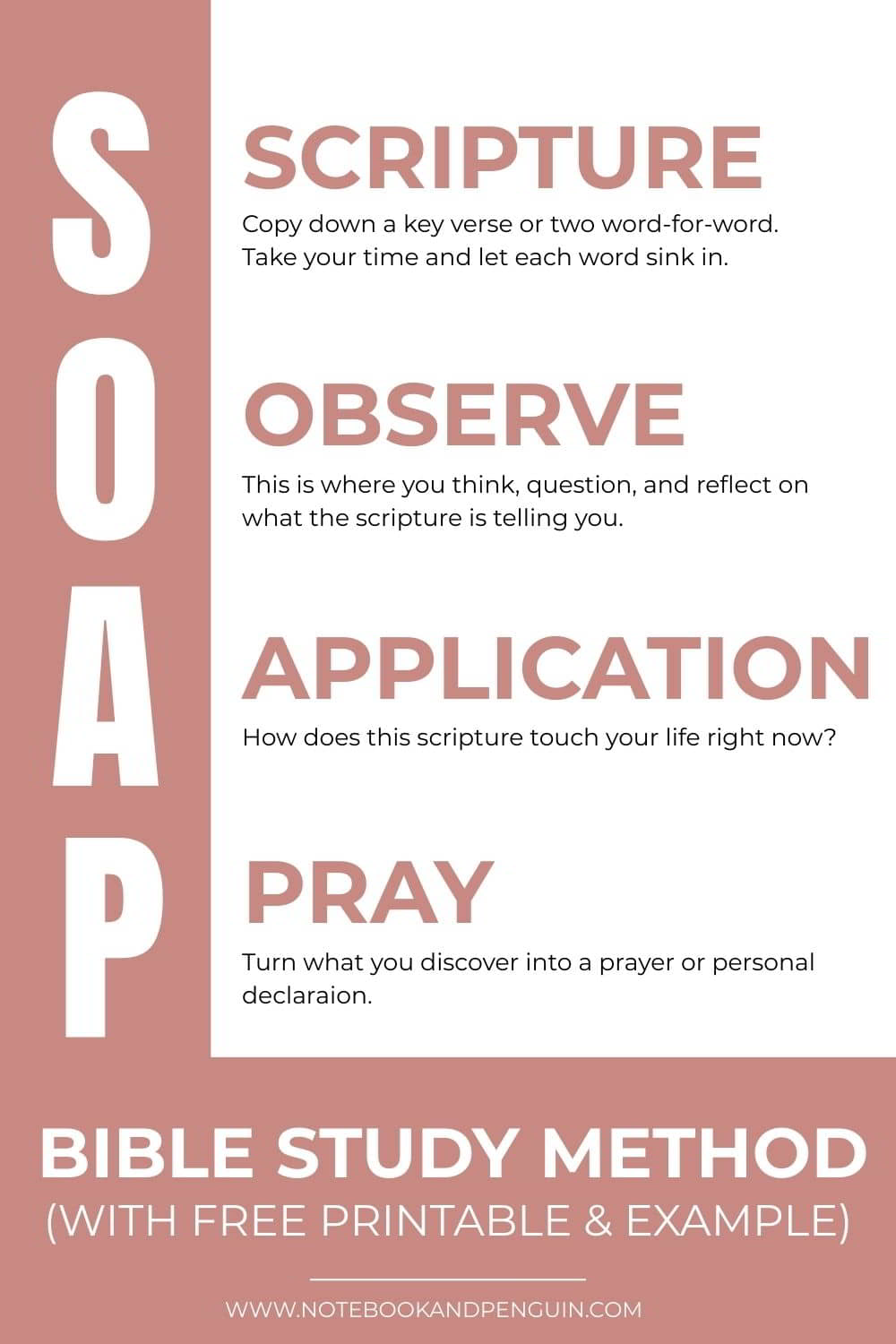
In this article, we are going to take a look at one of the most popular and easy ways to study the Bible – The SOAP Bible study method!
This method is great if you want something easy, practical, and doable for anyone. In fact, just like the WORD method, the SOAP method is so simple that you can use it with nothing more than your Bible, a pen, and a notebook (or download our free printable down below).
What I love about the SOAP method is how it helps you to intentionally slow down, soak in God’s word, and explore what it really means to you. For me, using a method like this has made a huge difference in the way I see and experience my quiet time with God.
If you are new to the Bible, then don’t forget to check out our articles on how to read the Bible for beginners or what’s the best order to read the Bible. These are a great foundation if you are just getting started!
What Is SOAP Bible Study?
The SOAP Bible study method is a simple, four-step method to reading the Bible that helps you go from simply seeing the words to really understanding them. It’s one of the most popular Bible study methods because it works for everyone and anyone – whether you’re brand new to reading the Bible or have been doing it for years.
What Does SOAP Bible Study Acronym Stand For?
SOAP is an acronym that stands for:
- Scripture
- Observation
- Application
- Prayer
Let’s take a look at each one:
Step 1 – S is for Scripture
This is as simple as it sounds: Start by picking a short Bible passage to focus on (use our Verse of the Day if you don’t know where to start!). It doesn’t have to be a whole chapter, sometimes just a few verses are perfect. The trick is to slow down and really listen to what you’re reading.
Write out the verse or verses in your notebook. Yes, actually write them! Writing things down has a way of making them stick, and there really is something powerful about studying scripture in this way. You’ll notice that writing helps you slow down and notice little details you may have skimmed over before.
Not sure where to start? Some great places are the Proverbs, a story from Jesus’ life, or perhaps a few lines from Paul’s letters. If you are stuck, use our verse of the day or pick a daily devotional to use as inspiration! Pick something that stands out to you or speaks to what you’re going through right now.
An example for S – Scripture
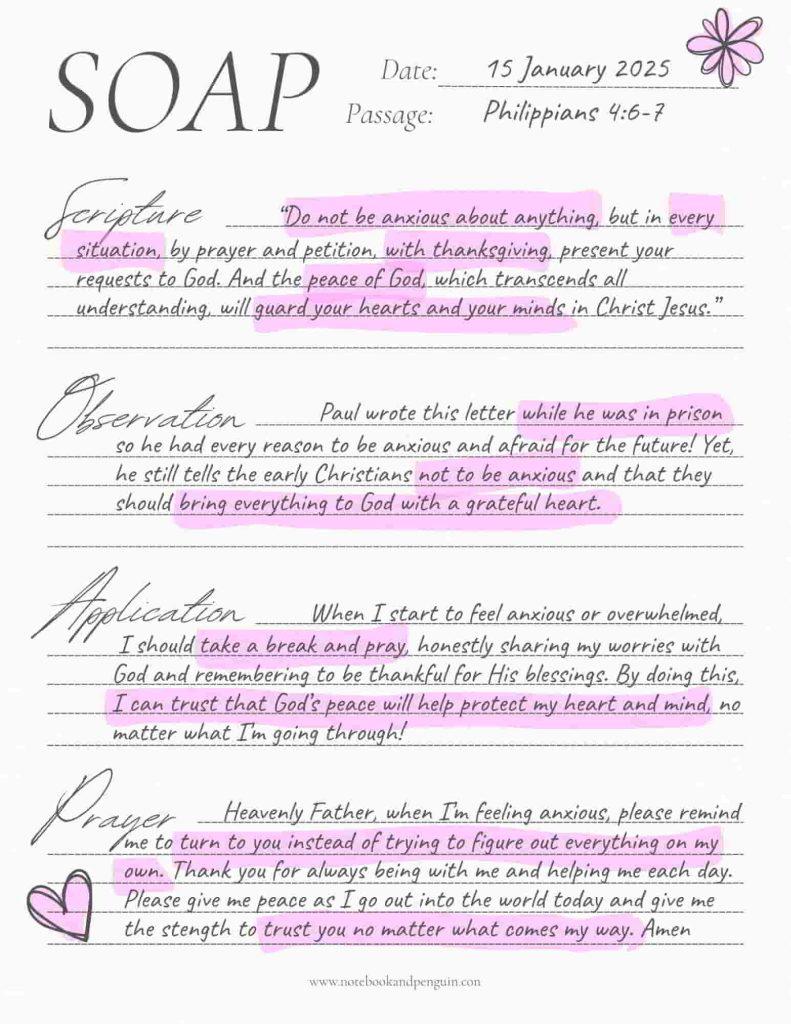
Let’s take a look at an example from Philippians 4:6-7 (we’ll continue to use this verse as we work through the rest of the SOAP method).
Write it out in your notebook or journal:
“Do not be anxious about anything, but in every situation, by prayer and petition, with thanksgiving, present your requests to God. And the peace of God, which transcends all understanding, will guard your hearts and your minds in Christ Jesus.”
(Philippians 4:6-7 NIV)
Step 2: O is for Observation
Here’s where you play detective and dig deeper. Take a good, honest look at what the passage is saying.
Here are ideas for questions you could ask yourself:
- Who is speaking or writing?
- Who is the intended audience?
- What is the main message or theme?
- What is the overall message of the passage of the book or chapter?
- Why do you think God included this in the Bible?
- Are there any commands or instructions? For example, is there something God or the writer is asking you to do?
- Are there any promises or warnings?
- Are there any words, phrases, themes, or ideas that are repeated or stand out?
- What questions do you have about the passage? Is there anything you don’t understand or would like to dig into?
- Does the passage give any specific details or examples that you think are important?
- Does the passage use stories or parables to illustrate a point?
- What do I learn about God from this passage? What does the passage reveal about God’s character?
- How does this passage make you feel? Is there anything that makes you feel challenged or uncomfortable?
- Where is this passage within the larger story of the Bible, and why do you think this could be important?
- Are there any cross-references or similar themes somewhere else in Scripture?
Don’t worry, you’re not looking for some hidden, super-spiritual meaning that only pastors and theologians can spot. Just pay attention to what’s actually there. You might want to underline or highlight words or phrases that catch your eye.
An Example For O – Observation
Continuing with our example from Philippians 4:6-7, let’s take a closer look at what the passage is saying (yours doesn’t need to be this detailed or fancy – this is just an example to show you what you could do):
Who is speaking/writing, and who is the audience?
Paul, the apostle, is writing a letter to the Philippian church. His audience includes both Jewish and Gentile believers.
What is the context for this verse?
Paul is writing this letter from prison. This is important because he is in a situation where anxiety and fear could easily take over his mind.
What is the theme or main message of this scripture?
Paul is telling believers not to be anxious but rather to bring all their worries to God.
Are there any commands or instructions?
Yes, there are:
- Do not be anxious about anything.
- Pray to God “in everything”, including the small, everyday stuff.
- Thankfulness should be part of our prayers, no matter how hard our lives might be.
- Bring your requests to god with a grateful heart.
Are there any promises or warnings?
Yes! God promises peace that will “guard your hearts and minds” – this is a supernatural peace.
Are there any words or phrases that stand out as important or are repeated?
- “Anxious” – The verse is specifically talking about worry and anxiety.
- “Prayer,” “supplication,” and “thanksgiving” – these words all highlight the ways to approach God.
- “Everything” – nothing is too small or too big to bring to God.
What do I learn about God?
God wants to give us peace no matter what we are going through, and He ask us to talk to Him about everything.
Step 3: A is for Application
Now comes the fun part: What does this scripture mean for you?
This is the step where you connect what you’ve read to real life – your life. Is there something God is nudging you to do? Do you need to think differently about a specific situation? Is there someone you need to encourage or forgive?
But don’t overthink it too much – sometimes a scripture might be obvious, for example, “I need to be kinder to my family”. Other times it might be just a simple reminder that God is with you and that you can trust Him.
Write down your thoughts and be honest with yourself, especially if there is anything that challenges you or makes you feel uncomfortable.
An Example For A – Application
Making Philippians 4:6-7 personal:
- “Today, when I start to feel stressed or worried, I’ll pause and talk to God about it instead. I’ll try to thank Him for the good things, even while I’m asking for help.”
- “God promises me peace when I bring my worries to Him. I don’t have to figure it all out on my own.”
Step 4: P is for Prayer
You made it to the last step!
After you’ve read, observed, and applied, now it’s time to talk to God about what you’ve learned. Thank Him for what He’s shown you. If you saw something you need to change, ask Him to help you. If you are worried, excited or confused, tell Him. Speak to Him like a friend, He loves to talk to you just as you are!
An example for P – Prayer
Here’s a prayer for our Philippians 4:6-7 example:
Heavenly Father,
I am feeling really anxious about ___________________ [describe your worry, e.g., “someone’s health” or “changes happening at work”].
Right now, I especially bring to You ___________________ [get specific, e.g., “my child’s illness,” “the upcoming job interview,” “our financial situation,” etc.].Please help me with ___________________ [describe exactly what you need help with, e.g., “making a decision,” “having peace,” “knowing what to do next,” etc.].
Guide me as I face ___________________ [name your situation or challenge], and remind me that You care about every detail, even the ones that seem small or silly to me.
Thank You for ___________________ [name something God has done for you in the past, e.g., “how You provided when I lost my last job,” “the comfort You gave me during a tough time,” “the friends who encouraged me,” etc.], and for ___________________ [another blessing, big or small].
Please fill my heart with Your peace, the kind that doesn’t make sense to the world but comes straight from You. Guard my heart and my mind today. Help me to trust You with ___________________ [name your specific concern one more time].
In Jesus’ name,
Amen.
If you are enjoying this article, please pin it so others can find it too!
SOAP bible Study Method Example
You can use your own favorite notebook or journal to practice the SOAP method, or you can use a template like the one shown in the example below.
If you like the format in the picture, you can download our SOAP method Bible study printable PDF for free! Choose whatever method feels most comfortable and helps you grow in your study, whether that’s your personal journal or this ready-to-use printable page.
More SOAP Bible Study Examples
Want to see the SOAP method with different types of verses? Here are two more quick examples:
Example 1: Psalm 23:1
S – Scripture: “The Lord is my shepherd, I lack nothing.”
O – Observation: David calls God his shepherd. Shepherds guide, protect, and provide for their sheep. If God is my shepherd, that means I’m His sheep – totally dependent on Him.
A – Application: I’ve been stressed about money this week. But if God is my shepherd, He knows what I need. I don’t have to panic. I can trust Him to provide.
P – Prayer: Lord, thank you that you’re my shepherd. Help me to trust you with my finances and remember that you see what I need.
Example 2: Ephesians 4:29
S – Scripture: “Do not let any unwholesome talk come out of your mouths, but only what is helpful for building others up according to their needs, that it may benefit those who listen.”
O – Observation: Paul gives both a negative (don’t let unwholesome talk out) and a positive (speak what builds others up). My words have power to either hurt or help.
A – Application: I complained about my coworker twice this week. That’s the opposite of building up. Today I’ll look for one genuine thing to encourage someone with.
P – Prayer: God, guard my mouth today. Help me to notice when I’m about to say something unhelpful and stop. Show me who needs encouragement.
These soap bible study examples show how the same method works for anything, from promises to instructions, and everything in between.
Want to dig deeper? Check out our beginner’s guide to the Inductive Bible Study Method which also comes with a free printable template!
Great SOAP Bible Study Verses & Ideas to Try
Not sure where to start? Here are some verses that work wonderfully with the SOAP method of Bible study:
- Philippians 4:6-7 – The example we used above, perfect for when you’re feeling anxious.
- Psalm 23 – A short, rich passage full of imagery about God’s care. We used the first verse in our example above.
- Proverbs 3:5-6 – Great for decisions and trusting God.
- Romans 8:28 – A powerful promise when life feels confusing.
- Joshua 1:9 – Encouragement when you’re facing something hard.
- Ephesians 4:29 – A practical verse about how we speak to others.
- Isaiah 40:31 – Hope for when you’re feeling tired or discouraged.
Pick one, grab your SOAP bible study notes page, and see what God shows you!
Ideas For Using the SOAP Method with Others
The SOAP method isn’t just for personal quiet time, it works great in groups too!
For small groups: Have everyone do their own SOAP study during the week on the same passage. Then share your Observations and Applications when you meet. You’ll be amazed how different people notice different things!
For families: Keep it simple with younger kids. Just read one verse, ask “what do you notice?” (Observation), “what should we do about this?” (Application), and say a short prayer together (Prayer).
For study buddies: Pick a book of the Bible and work through it together using the SOAP method. Text each other your verses or share what God’s showing you.
Tips for Making the Most of Your SOAP Study Time
- Try using the SOAP Bible study method each day, even if it’s just one verse! If you don’t have time for writing on a particular day, take time to think about the scripture using the SOAP steps.
- Use a journal or notes app that you enjoy or use a SOAP Bible study worksheet or printables to organize your thoughts.
- The SOAP method works really well for small groups and family Bible time so find someone to study with!
- It doesn’t have to be perfect, you’re not preparing for an exam or writing a sermon! This is just for you and God. Be honest, be yourself, and don’t stress about saying the “right” things in the “right” way.
- Don’t worry if you miss a day or feel stuck. God loves your heart and your effort, not perfection!
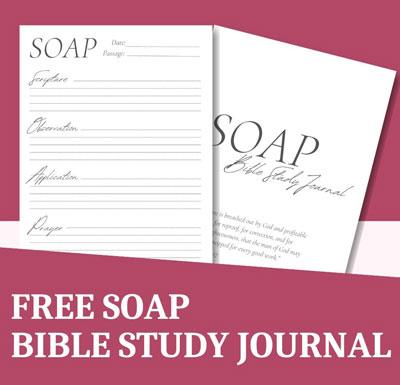
Download our free SOAP Bible Study PDF Template
If you would like to use the free SOAP Bible study printable I created, you can download it here – it comes with:
- The SOAP template, which you can use to make as many copies as you need.
- A list of SOAP Bible study questions and ideas you can use to dig deeper into each scripture.
- An example.
- A journal cover that you can use if you want to create your own SOAP Bible study journal with your templates.
- The template comes in PDF format so it is easy to print or use in your favorite note-taking app.
Frequently Asked Questions About the SOAP Method
What is SOAP Bible Study?
SOAP bible study is a method that uses four simple steps – Scripture, Observation, Application, and Prayer – to help you understand and apply what you read in the Bible.
What does SOAP stand for in Bible study?
In bible study, SOAP stands for Scripture, Observation, Application, and Prayer. It’s an easy way to remember the four steps.
How do you use the SOAP method for Bible study?
Start by writing down a verse (Scripture). Then write what you notice about it (Observation). Next, ask how it applies to your life (Application). Finally, pray about what you’ve learned (Prayer).
Is there a free SOAP Bible study printable?
Yes! You can download our free SOAP bible study printable PDF above. It includes a blank template, example, and questions guide.
Where can I find a SOAP Bible study template?
We have a free SOAP Bible study template available for download. Just enter your email above, and we’ll send it right to you.
What’s a good SOAP Bible study example?
In this article, we walk through a complete SOAP bible study example using Philippians 4:6-7. You can see exactly how each step works with a real Bible verse.
Can I use the SOAP method for journaling?
Absolutely! Many people love SOAP bible journaling because it gives structure to their quiet time while still feeling personal and creative.
Other Bible Study Methods To Try
We’ve created a collection of other Bible study methods that you can use if you want to try something new. Each of them also come with free PDF templates to help you get started. Check them out here!
Final Thoughts
You don’t need a fancy degree or complicated method to study the Bible or spend quality quiet time with Jesus. The SOAP method is easy and powerful, and it can be used by anyone who wants to spend real time in God’s Word learning and growing. So grab your Bible, a pen, and dive in – soon the SOAP method will become second nature to you!