

When Life Doesn’t Add Up.
Have you ever looked at your circumstances, or someone else’s, and wondered, “If God really cares for His people, why do some people struggle so much? Why do some blessings seem out of reach?” You’re not alone. These questions are as old as faith itself, and the tension between what we experience and what we read in Scripture can be very real.
King David, the writer of Psalm 37, wasn’t a stranger to life’s tough questions. He knew what it was like to have little and to have a lot, to run for his life, to wait on God for decades, and to stand in wonder at God’s unexpected provision.
By the time he wrote Psalm 37, David was older and wiser, having walked with God through every possible high and low. He looked back and wrote today’s scripture, not as a quick afterthought, but as the reflection of a lifetime.
The Scripture
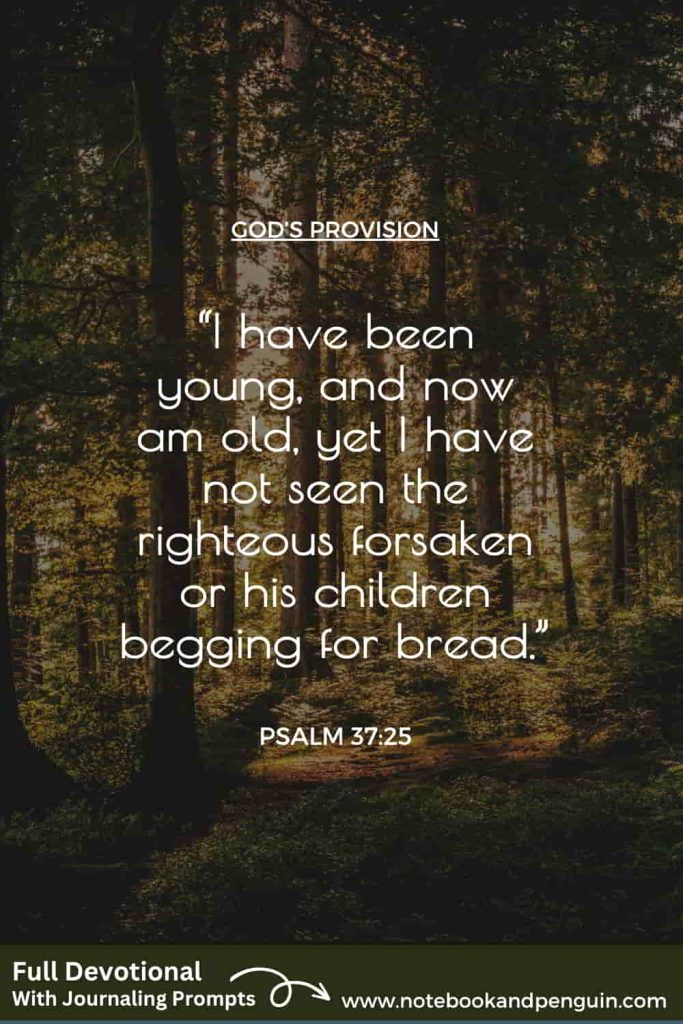
“I have been young, and now am old, yet I have not seen the righteous forsaken or his children begging for bread.”
Psalm 37:25 (ESV)
Breaking Down the Verse
Let’s take some time to listen to what David is saying, and not saying.
“I have been young, and now am old…”
David’s perspective comes from years of experience. He isn’t just being philosophical, he’s sharing what a lifetime of trusting God has taught him. Age brings wisdom, and sometimes what doesn’t make sense in the moment becomes clearer with time.
“…yet I have not seen the righteous forsaken…”
To be “forsaken” is to be completely abandoned, cut off with no hope. David’s observation: even in the worst times, God doesn’t permanently walk away from those who are His.
“…or his children begging for bread.”
Is this a guarantee of easy living? No. Scripture is clear, sometimes believers face real danger, worry, and need. David uses a figure of speech for deep, generational abandonment and despair. His point is not that God’s people never face want or difficulty, but that God does not allow His beloved children to be utterly destitute without hope or help.
What About Reality?
It’s natural to ask: “Don’t some faithful people go hungry?” It’s true, we live in a broken world, and suffering happens, even to the righteous. Psalm 37:25 is not a blanket promise that poverty will never touch a believer’s life. Rather, this is an “I’ve seen it over the long haul” kind of encouragement. The psalm zooms out to a wider view that goes beyond today’s pain, reminding us that God’s story for His people is never defined by a temporary lack but by His ongoing presence, provision, and care.
How Do We Live Psalm 37:25?
- Remember God’s Track Record – Think about times God provided in ways you could not have predicted. Write them down.
- Redefine “Abandoned” – Feeling alone doesn’t make you alone. Lean into God’s promise that He sticks closer than a friend.
- Notice God’s Provision – Start a “daily bread journal.” Record any way God meets a need, big or small: a meal, encouragement, a bill paid, peace in stormy times. Over time, take note of any patterns of His care.
- Help Someone Else – Often, God uses people to answer prayers for provision. Ask Him to show you someone’s unspoken need. Can you be the answer to their prayer today?
- Pass Along Blessings – David notes that descendants are blessed through the righteous, not just financially, but by learning trust, generosity, and hope from their parents and mentors.
Reflection Questions
- Has there been a time when you have experienced God’s unexpected provision in ordinary or extraordinary ways?
- If you’ve felt “forsaken” by God, what kept you hanging on to faith? Looking back, can you see His hand at work?
- How does your definition of “being provided for” compare to God’s? Where do you think it might need to change?
- Has God ever met your needs through someone else? How did this make you feel?
Affirmation
God is faithful in every season, even when I can’t see it.
Closing Prayer
Heavenly Father,
Thank You for never forsaking me. You have seen me through times of plenty and through times of real need. Sometimes I get discouraged, and sometimes I even wonder if You see me at all. Remind me today that Your faithfulness stretches far beyond what my eyes can see. Help me notice Your daily provision, whether it’s in obvious blessings or quiet moments of peace. Make me aware of the needs around me and use me as Your hands and heart. Keep me generous, keep me humble, and keep me trusting in Your goodness from my youth to my old age. May my life be a living testimony to Your unfailing love.
In Jesus’ name, Amen.